
AI Governance for Mid-Sized Companies: How to Enable Innovation Without Risk
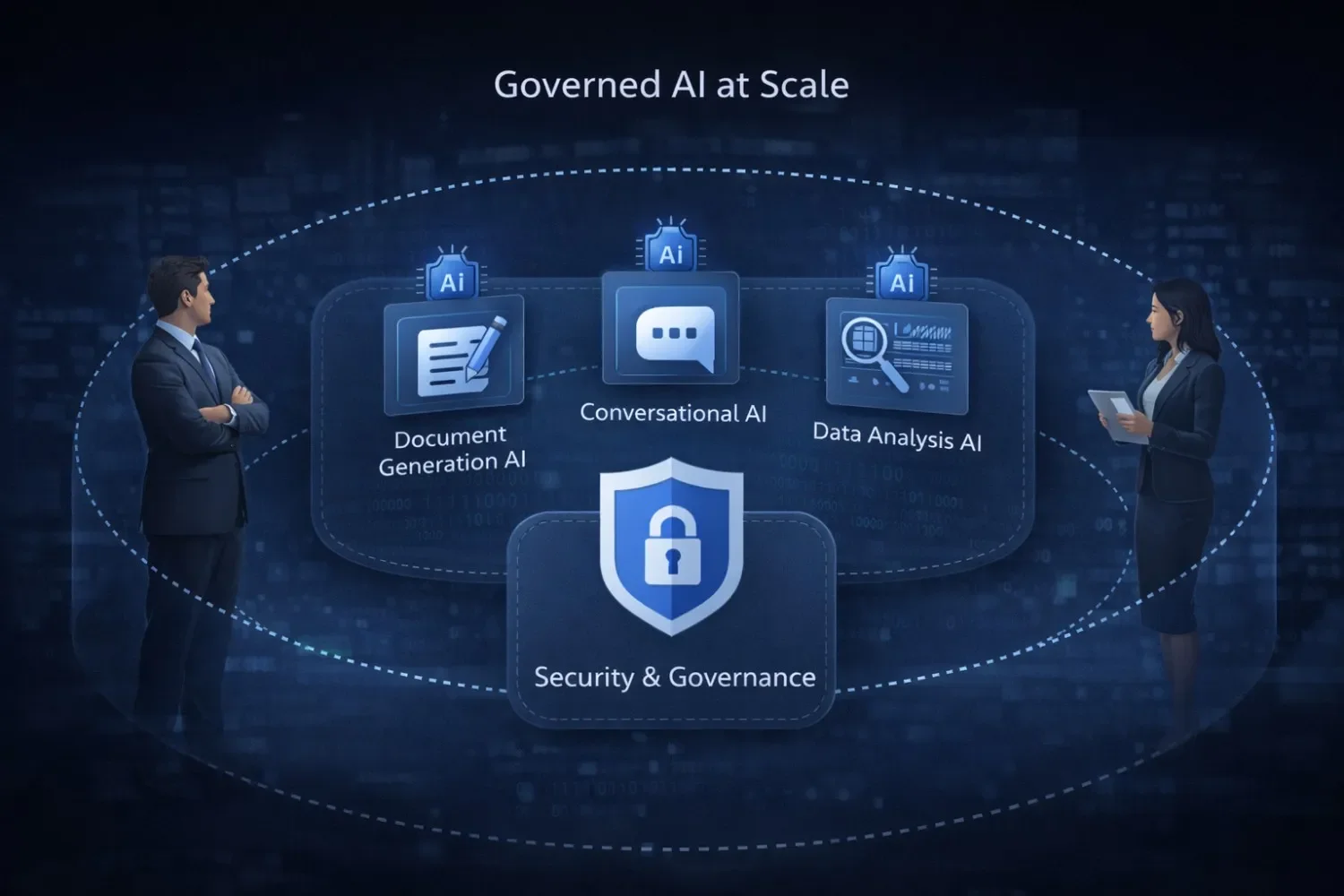
Governance enables AI innovation at scale
Share This Story, Choose Your Platform!
AI adoption in mid-sized organizations is accelerating faster than policy, training, or oversight can keep up. Employees are already using copilots, generative tools, and automation, often without guidance, consistency, or awareness of risk.
Some organizations respond by banning AI outright. Others ignore the issue entirely. Both approaches fail.
AI governance, when designed correctly, does not slow innovation. It prevents chaos, protects trust, and allows AI usage to scale without fear. For organizations with 100 to 1000 users, governance is the difference between sustainable advantage and unmanaged exposure.
Why AI Governance Is Now Unavoidable
AI introduces risks that traditional IT policies were never designed to address.
Emerging governance risks
Data leakage through prompts
Use of unapproved or consumer-grade AI tools
Hallucinated outputs mistaken for facts
Regulatory exposure from automated decision-making
Intellectual property contamination
Loss of auditability and accountability
Ignoring these risks does not make them disappear. It ensures they surface in uncontrolled ways.
The Two Governance Failures to Avoid
Failure 1: Total Restriction
Banning AI tools or locking them down completely leads to predictable outcomes.
Consequences of prohibition
Shadow AI usage
Employees using personal accounts and devices
Loss of visibility and control
Missed productivity gains
Prohibition drives risk underground rather than eliminating it.
Failure 2: Total Freedom
Unrestricted AI usage creates a different set of problems.
Consequences of ungoverned use
Inconsistent outputs
Accidental data exposure
Compliance violations
Erosion of trust in AI-generated work
Freedom without structure creates systemic risk.
What Effective AI Governance Actually Looks Like
Effective governance is enabling rather than punitive. It answers five questions clearly.
Core governance questions
Who can use AI tools
Which tools are approved and why
What data can be used and in what context
How outputs are validated and reviewed
How usage is monitored and improved over time
Governance defines boundaries and then encourages adoption within them.
Core Components of Mid-Market AI Governance
Tool Standardization
Governance starts by defining approved platforms that align with security and compliance needs. Most mid-market organizations standardize on tenant-bound, enterprise-grade tools such as Microsoft Copilot and Azure AI services rather than consumer AI platforms.
Standardization reduces risk while simplifying training and support.
Data Classification and Access Control
AI is only as safe as the data it can access.
Effective governance relies on sensitivity labeling, DLP enforcement, least-privilege access, and clear rules for prompt data usage. These controls prevent accidental exposure without blocking productivity.
Usage Guidelines and Guardrails
Employees need clarity rather than legal language.
Effective guidelines explain what AI can and cannot be used for, how outputs should be validated, when human review is required, and how concerns are reported.
Clear guidance builds confidence and consistency.
Training Through Practice
Governance fails without education.
Hands-on training teaches responsible prompting, bias and hallucination awareness, safe data handling, and real-world use cases by role.
Training transforms policy from theory into behavior.
Monitoring and Continuous Improvement
Governance is not static.
Organizations must monitor AI usage patterns, identify emerging risks, adjust policies as tools evolve, and capture successful use cases. Governance matures alongside adoption.
Why Mid-Market Organizations Need a Different Approach
Enterprise governance frameworks are often too heavy. Small business approaches are often too loose.
Mid-market organizations require governance that is lightweight, practical, enforceable, aligned with real workflows, and supported by technology rather than manual oversight.
Achieving this balance internally is difficult without experience.
How Nexigen Designs AI Governance That Works
Nexigen builds AI governance programs that align security, productivity, and compliance.
Our Approach
We assess current AI usage, including shadow AI. We define approved tools and data boundaries. We configure technical controls in Microsoft and cloud platforms. We deliver experiential training. We establish monitoring and review processes.
The result is an environment where AI usage is visible, safe, and scalable rather than feared or forbidden.
What Leaders Should Decide Now
AI is already inside your organization. The only question is whether it is governed.
Leaders must decide whether AI usage will be intentional or accidental, whether productivity gains will be trusted or questioned, and whether risk will be managed proactively or discovered too late.
Governance is how organizations choose the first option in each case.
Conclusion
AI governance is not about slowing down. It is about making acceleration safe.
Mid-sized organizations that design governance thoughtfully unlock innovation without sacrificing security, compliance, or trust. Those that delay governance inherit invisible risk.
Nexigen helps organizations build AI governance that works in the real world, enabling progress without regret.
Request an AI Governance Readiness Assessment
For organizations ready to enable AI innovation with confidence and control, a readiness assessment is the right starting point.
Schedule a 30-minute consultation with our expert team
Breathe. You’ve got IT under control.
Ready to integrate Nexigen into your IT and cybersecurity framework?
Refine services and add-ons to finalize your predictable, no-waste plan
Complete the form below, and we’ll be in touch to schedule a free assessment.
Ready to Take the Next Step? Let’s Talk
Have questions or want to learn more about how we can help your business? Fill out the form below and a member of our expert team will reach out shortly.