
The Hidden Risk in Hybrid Environments: Where Security Breaks First
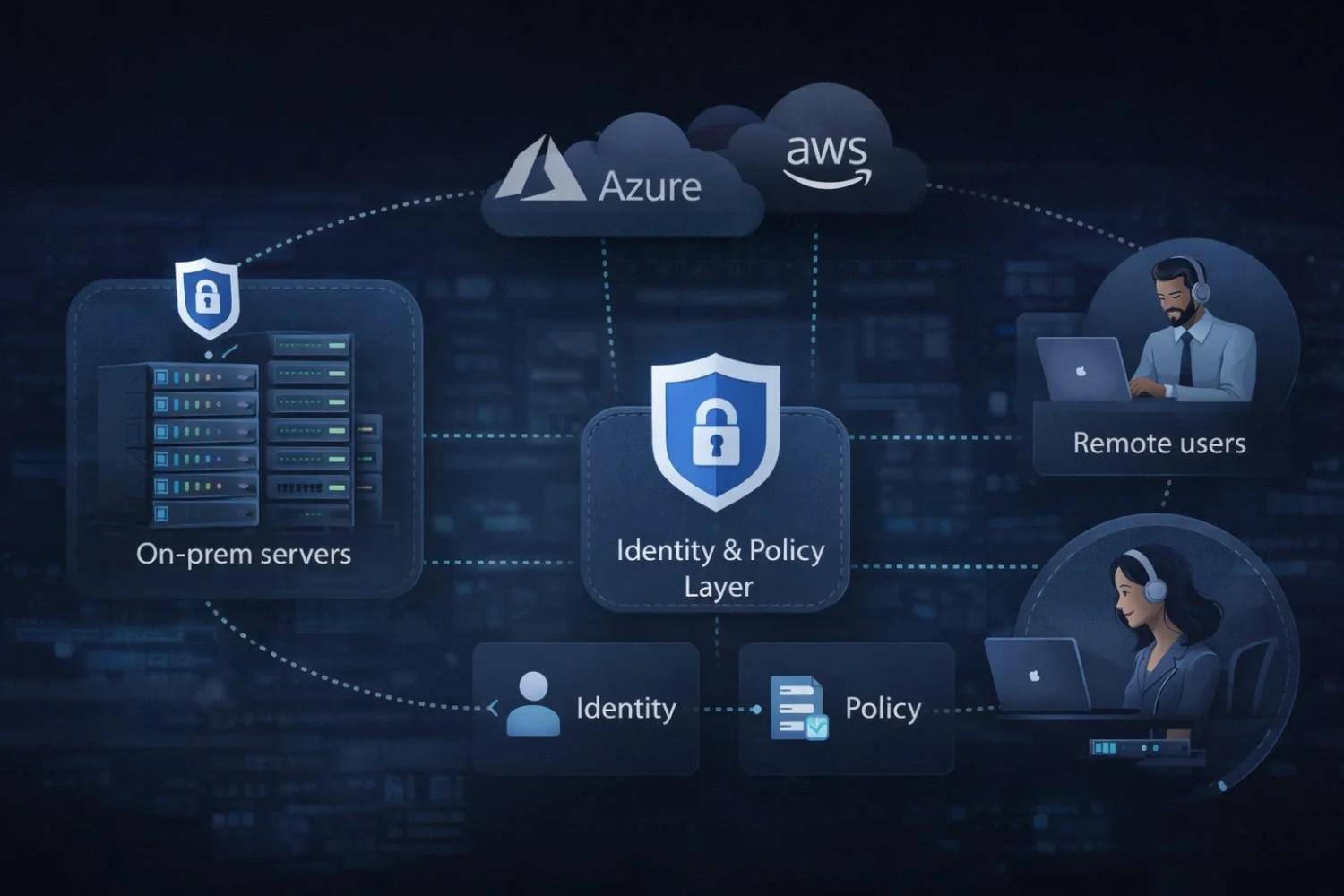
Hybrid security fails at the seams
Share This Story, Choose Your Platform!
Hybrid environments promise flexibility. They deliver complexity.
For mid-sized organizations, hybrid infrastructure is the default state. A mix of on-prem systems, Azure workloads, SaaS platforms, and remote access defines daily operations. It is also where security assumptions quietly collapse. Controls that function well in isolation often fail at the boundaries between systems.
Attackers understand this reality. They do not breach hardened perimeters directly. They move through gaps created by inconsistent identity, misaligned policies, and incomplete visibility.
Hybrid security does not fail everywhere. It fails first in very specific places.
Failure Point 1: Identity Drift
Identity is the connective tissue of hybrid environments and the most common point of failure.
Typical identity weaknesses
On-prem Active Directory and cloud identity falling out of sync
Legacy authentication protocols left enabled indefinitely
Service accounts holding excessive privileges
Conditional access applied inconsistently
MFA exclusions expanding quietly over time
Once identity weakens, attackers move laterally with minimal resistance. This is why organizations increasingly adopt identity-first security architectures that treat hybrid identity as a single control plane rather than two loosely connected directories.
Hybrid identity must be governed centrally or it becomes the easiest attack path.
Failure Point 2: Inconsistent Policy Enforcement
Security policies often exist. They simply do not apply everywhere.
Common enforcement gaps
Strong cloud policies paired with weak on-prem enforcement
Endpoint compliance required in some applications but not others
VPN access bypassing Zero Trust controls
SaaS platforms operating outside centralized governance
Attackers exploit the weakest enforcement point, not the strongest. This is why Zero Trust initiatives fail when policy consistency is treated as optional rather than foundational.
Failure Point 3: Network Trust Assumptions
Hybrid networks frequently retain outdated trust models.
Legacy assumptions still present
Flat internal networks
Overly permissive firewall rules
VPNs granting broad internal access
Limited east-west traffic inspection
Once attackers gain access, internal movement often encounters little resistance. Modern hybrid security assumes the internal network is hostile and designs controls accordingly.
Failure Point 4: Cloud Security Posture Gaps
Cloud workloads introduce new risk when governance fails to keep pace with deployment.
Common posture failures
Default configurations left unchanged
Excessive permissions in cloud roles
Inconsistent logging and monitoring
Shadow workloads outside security oversight
Cloud platforms do not fail securely by default. They fail quietly when posture management is neglected. This is why continuous cloud security posture management is critical in hybrid environments.
Failure Point 5: Visibility Fragmentation
Hybrid environments generate telemetry everywhere but insight nowhere.
Symptoms of fragmented visibility
Logs exist but are not correlated
Alerts fire without context
No unified view of user behavior across systems
Incidents investigated in isolation
Without unified visibility, detection slows and response becomes incomplete. Effective hybrid security depends on correlating identity, network, endpoint, and cloud telemetry into a single operational picture.
Why These Failures Persist
Hybrid environments evolve incrementally. Each change feels minor. Risk compounds invisibly.
Security teams often rely on assumptions such as “that system is not internet-facing” or “we will clean that up later.” Attackers depend on those assumptions.
How Nexigen Secures Hybrid Environments Correctly
Nexigen approaches hybrid security as an architectural discipline rather than a collection of tools.
Identity-Centric Design
Unified identity governance, elimination of legacy authentication, and strict conditional access enforcement across all environments.
Policy Consistency
Security policies applied uniformly across cloud, SaaS, and on-prem systems with no unexamined exceptions.
Network Modernization
Secure SD-WAN and segmentation paired with Zero Trust Network Access to replace broad VPN access.
Cloud Posture Management
Continuous configuration assessment, least-privilege enforcement, and automated remediation.
Unified Visibility
Centralized logging, correlation, and threat detection across identity, network, and workloads.
This approach is not about adding tools. It is about removing blind spots.
What Mid-Market Leaders Should Audit First
If you operate a hybrid environment, start by answering these questions:
Are all authentication paths protected equally
Do security policies behave the same in cloud and on-prem systems
Can you trace a user’s access across systems in one view
Are default cloud configurations still in place
Would lateral movement be detected quickly
If any answer is uncertain, risk already exists.
Conclusion
Hybrid environments rarely fail catastrophically. They erode quietly. Security breaks first at the seams where systems meet and assumptions linger.
Mid-sized organizations that secure those seams gain disproportionate resilience. Those that do not inherit invisible risk.
Nexigen specializes in securing hybrid environments as integrated systems rather than disconnected parts, exactly where real-world security succeeds or fails.
Request a Hybrid Security Posture Assessment
For organizations ready to identify where hybrid security breaks first and how to close those gaps, a structured assessment is the most effective starting point.
Complete the form below, and we’ll be in touch to schedule a free assessment.
Ready to Take the Next Step? Let’s Talk
Have questions or want to learn more about how we can help your business? Fill out the form below and a member of our expert team will reach out shortly.