
Why Network Performance Is Now a Business KPI (Not Just an IT Metric)
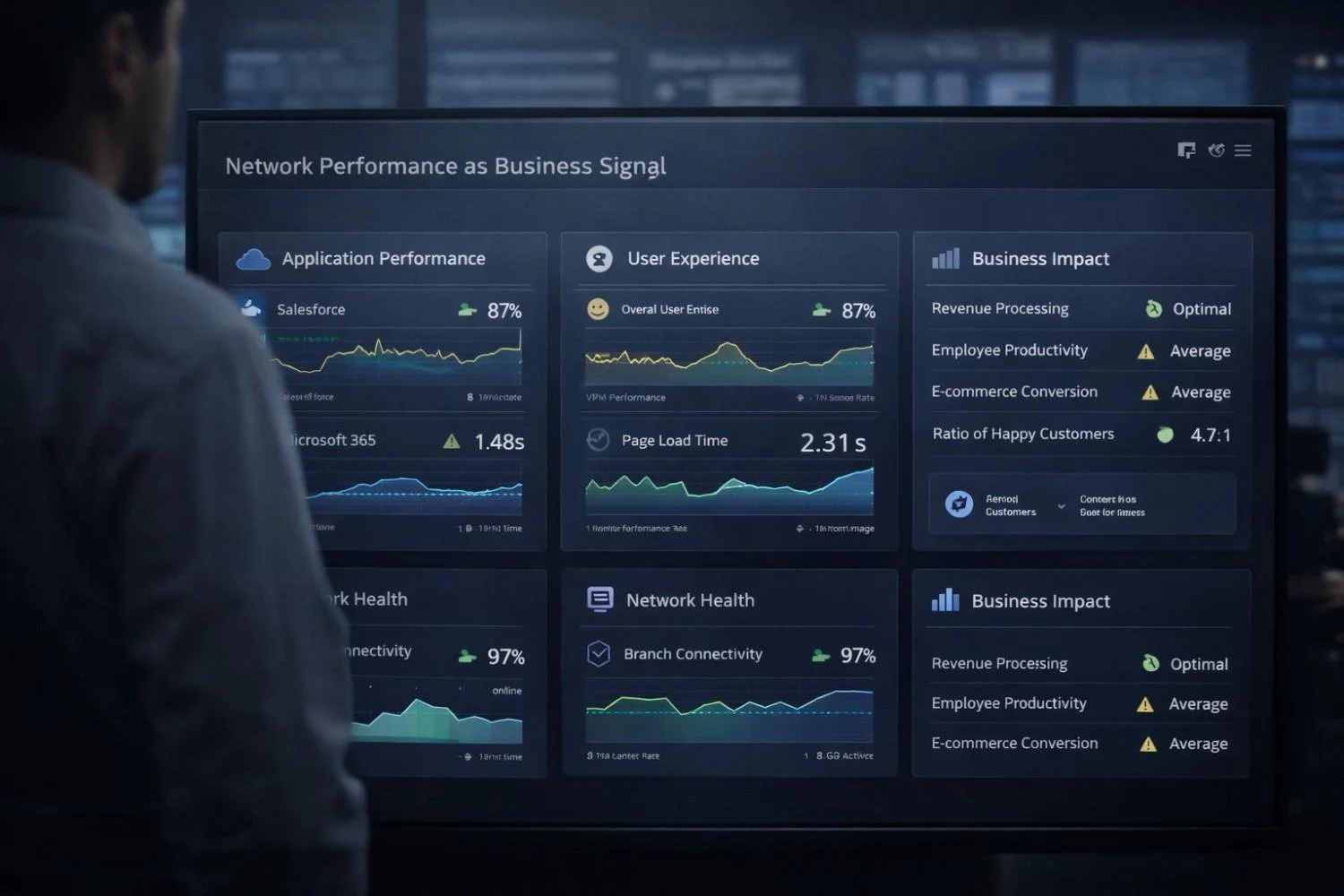
Network performance now defines business performance
Share This Story, Choose Your Platform!
For years, network performance lived quietly inside IT dashboards. Latency, packet loss, and jitter were important but abstract. As long as the network was up, leadership assumed it was fine.
That assumption no longer holds.
In cloud-first, SaaS-heavy, hybrid-work environments, network performance directly determines how fast employees work, how reliably customers interact with the business, and how resilient the organization remains under pressure. When the network falters, productivity degrades quietly but persistently.
The most effective organizations now treat network performance as a business KPI rather than a background technical detail.
Why the Network Became Business-Critical
Three structural shifts changed the role of the network entirely.
Applications Moved Off the LAN
Critical systems now live in SaaS platforms and public cloud environments. Every transaction, workflow, and interaction depends on network quality.
Work Became Distributed
Employees operate from branches, homes, and mobile locations. The network is no longer centralized, but performance expectations are.
Security Became Inline
Inspection, authentication, and policy enforcement now sit directly in traffic paths. Poorly designed networks amplify security latency rather than absorbing it.
The network is no longer a pipe. It is the delivery mechanism for the entire business.
The Hidden Business Cost of Poor Network Performance
Network issues rarely trigger alarms at the executive level, but their impact is measurable.
Productivity Drag
Slower application response times, repeated logins, dropped sessions, and delayed collaboration quietly tax every employee.
Even small delays compound across hundreds of users.
Revenue Impact
Transaction processing slows. Client-facing applications feel unreliable. Sales and service teams respond more slowly.
Operational Risk
Support tickets increase. Mean time to resolution rises. Teams rely on brittle workarounds.
Security Exposure
Controls are disabled to improve performance. Policies are bypassed during outages. Shadow IT expands.
Performance problems rarely stay isolated.
Why Traditional Metrics No Longer Work
Legacy network metrics focus on uptime, bandwidth utilization, and link availability.
These measurements miss the point.
A network can be up and still unusable. A circuit can be available and still slow. Bandwidth can be plentiful and still misrouted.
Modern networks must be evaluated based on:
Application performance
User experience
Path efficiency
Policy enforcement latency
Failure recovery time
These are business-aligned measures.
How Modern Networks Deliver Business Outcomes
Modern network architectures align technical performance with business impact.
SD-WAN
SD-WAN routes traffic based on application performance rather than static rules, avoids congested paths automatically, and dramatically improves SaaS responsiveness.
SASE
Secure Access Service Edge applies security policies without backhauling traffic, reducing latency for remote and mobile users while maintaining consistent performance.
AIOps
AIOps identifies degradation before users complain, correlates network behavior with application impact, and enables proactive remediation.
Together, these approaches convert network operations from reactive maintenance into performance engineering.
Why Mid-Market Organizations Struggle Here
Most mid-sized organizations inherited network designs optimized for a different era.
Cloud services and security layers were added without re-architecting. Performance accountability was delegated to carriers. Visibility into application-level experience remained limited.
The network works, but not well enough to support modern expectations.
How Nexigen Aligns Network Performance With Business KPIs
Nexigen designs and operates networks with explicit business outcomes in mind.
Application-Centric Design
Traffic is routed based on what matters most to the business, not static policies.
Performance Visibility
Monitoring focuses on application experience and user impact rather than link health alone.
Integrated Security
Security controls are enforced without unnecessary latency or bottlenecks.
Predictive Operations
Degradation is addressed before it becomes visible to users.
Executive Reporting
Network performance is translated into metrics leadership understands.
Clients consistently report faster application response, fewer user complaints, lower ticket volumes, and improved SLA performance.
What Leaders Should Ask Their IT Teams
Leaders should ask:
Which applications are most sensitive to latency
Where users experience delays today
Whether performance can be seen by application and location
How quickly degradation is detected and resolved
Whether security adds unnecessary friction
If these questions lack clear answers, network performance is already a business risk.
Conclusion
In modern organizations, the network is no longer invisible infrastructure. It is the circulatory system of the business.
Treating network performance as a business KPI aligns IT investment with productivity, resilience, and growth.
Nexigen helps mid-sized organizations design, operate, and optimize networks that serve the business rather than simply keeping systems online.
Request a Network Performance & Experience Assessment
For organizations ready to align network performance with business outcomes, a structured assessment is the right starting point.
Schedule a 30-minute consultation with our expert team
Breathe. You’ve got IT under control.
Ready to integrate Nexigen into your IT and cybersecurity framework?
Refine services and add-ons to finalize your predictable, no-waste plan
Complete the form below, and we’ll be in touch to schedule a free assessment.
Ready to Take the Next Step? Let’s Talk
Have questions or want to learn more about how we can help your business? Fill out the form below and a member of our expert team will reach out shortly.