
The 7 Core Principles of Cybersecurity That Protect Business Growth
The 7 Core Principles of Cybersecurity That Protect Business Growth
Cybersecurity failures rarely remain confined to IT. A compromised account can stop invoicing. An unavailable production system can delay orders. A breached vendor can expose customer information. By the time a security incident reaches the executive team, the problem is usually operational, financial, legal, or reputational.
The 2026 Verizon Data Breach Investigations Report examined more than 31,000 incidents and more than 22,000 confirmed breaches. Vulnerability exploitation became the leading initial-access vector, ransomware appeared in 48% of breaches, and third-party involvement reached 48%. IBM separately reported a 2025 average U.S. breach cost of $10.22 million among the organizations it studied. These figures describe investigated breaches not the probability that any particular company will suffer one but they make the business exposure unambiguous.
Managed cybersecurity services give organizations continuing access to security monitoring, engineering, incident response, and risk-management expertise without requiring every capability to be staffed internally. Their value, however, depends on how the program is designed and operated. Buying another security product does not resolve unclear ownership, unpatched vulnerabilities, weak identity controls, or an untested recovery plan.
The following seven principles separate a functioning cybersecurity program from a collection of expensive tools.
1. Start With Business Risk, Not a Product List
A useful security program begins by identifying the operations, information, systems, and third parties the business cannot afford to lose. A hospital, manufacturer, professional-services firm, and financial institution may use similar technologies, but interruption, confidentiality, and regulatory risk affect them differently.
NIST’s Cybersecurity Framework 2.0 is designed for organizations of every size, sector, and maturity. Its outcomes help leaders understand, assess, prioritize, and communicate cybersecurity risk rather than prescribing a single technology stack. CISA likewise assigns senior leadership a direct role in setting security objectives, supporting accountable ownership, and approving incident-response plans.
A managed cybersecurity provider should therefore begin with a documented assessment and prioritized risk register. The resulting plan should explain what matters, what is exposed, what will be corrected first, who owns each decision, and how improvement will be measured.
2. Protect Identity Before Adding More Perimeter Technology
Employees, contractors, administrators, applications, service accounts, and AI agents all possess some form of identity. Attackers frequently exploit those identities because a valid login can look less suspicious than malicious software.
The 2026 DBIR found that credential abuse remained present throughout attack paths even after vulnerability exploitation became the most common initial-access vector. It also reported unresolved cloud exposures involving missing MFA, weak passwords, and excessive permissions. CISA recommends technically enforcing MFA, reviewing compliance regularly, and protecting administrator accounts rather than relying on voluntary enrollment.
Strong identity security includes phishing-resistant authentication where appropriate, least-privilege access, separate administrator accounts, prompt onboarding and offboarding controls, credential rotation, and detection of abnormal sign-in behavior. If identity is weak, spending more on downstream detection merely makes the inevitable alerts more expensive.
3. Treat Vulnerability Management as a Business Discipline
Scanning is useful only when findings lead to action. The 2026 DBIR reported that only 26% of vulnerabilities in CISA’s Known Exploited Vulnerabilities catalog were fully remediated in the organizations studied, while median full-resolution time increased to 43 days. The practical problem is prioritization: most organizations can discover vulnerabilities faster than they can correct them.
An effective managed program should combine asset inventory, external-exposure discovery, vulnerability scanning, exploit intelligence, business criticality, remediation ownership, and verification. Internet-facing systems, known exploitation, privileged attack paths, and systems supporting essential operations generally deserve attention before an undifferentiated backlog of lower-value findings.
The metric that matters is not how many vulnerabilities a scanner produced. It is whether the exposures most likely to cause material harm are being removed quickly and verifiably.
4. Monitor Continuously and Define What Happens After Detection
Security tools create signals. They do not automatically create judgment, containment, or recovery. A provider’s monitoring service must clarify who investigates an alert, who can isolate an endpoint, who contacts the client, what evidence is preserved, and when incident responders become involved.
This distinction is fundamental when comparing an MSSP with managed detection and response. Basic monitoring may notify the customer; a mature MDR service investigates context and performs agreed response actions. Nexigen publicly lists managed SIEM, EDR, MDR, XDR, 24×7 security operations, incident response, and digital forensics among its cybersecurity capabilities.
A useful service agreement should specify coverage hours, severity definitions, escalation paths, response authority, communication methods, and reporting. “24/7 monitoring” is incomplete unless the buyer understands what a human analyst is permitted and obligated to do at 2:00 a.m.
5. Build Recovery Into Security Before an Incident
Prevention will sometimes fail. Resilience depends on containing damage and restoring essential operations without improvisation.
CISA recommends written incident-response plans, tested backups, restoration procedures, and recurring tabletop exercises involving leadership. IBM similarly recommends testing response plans and restoration, defining responsibilities for technical and nontechnical leaders, and restricting privileged access to limit the scope of an incident.
Recovery planning should establish acceptable downtime and data loss for each critical operation. Backups must be protected from the same credentials and systems they are intended to recover. Tabletop exercises should include executives, legal counsel, communications, operations, insurance contacts, and the managed security provider not only IT.
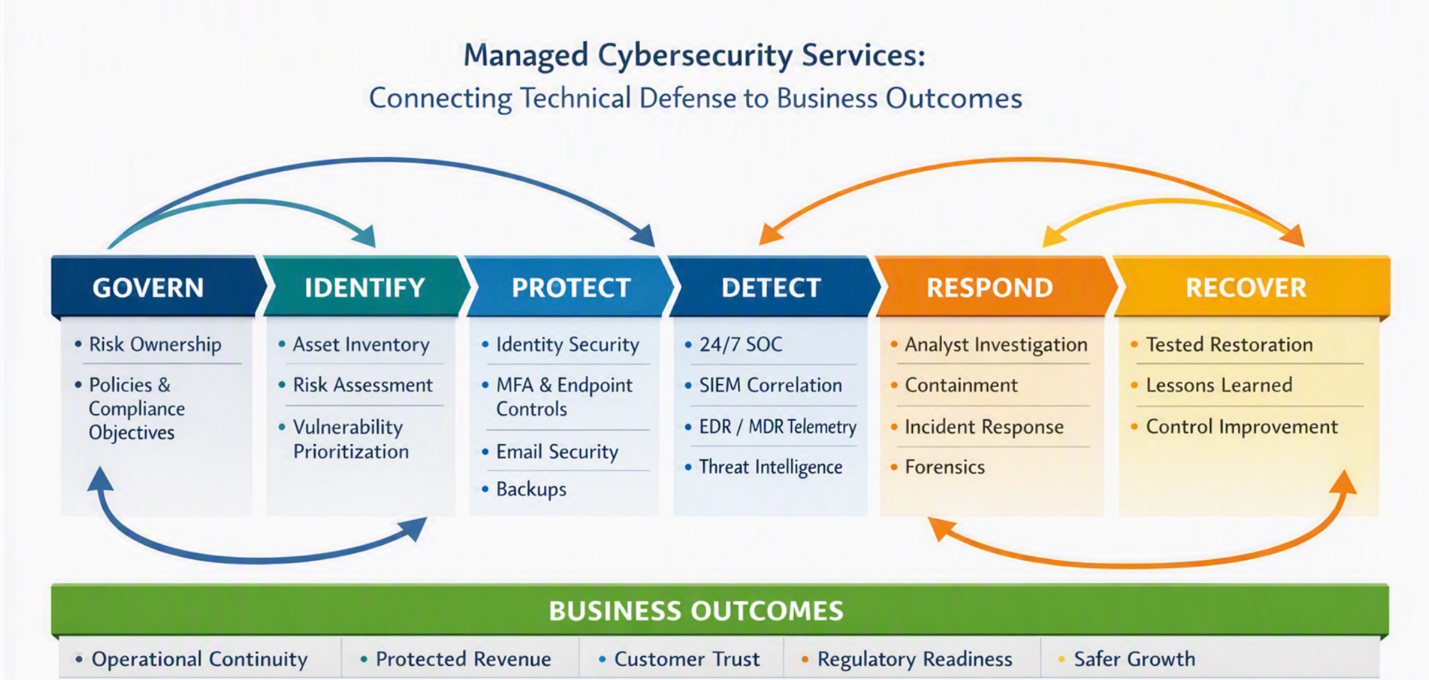
As shown below, managed cybersecurity produces business value through a continuing cycle of governance, identification, protection, detection, response, recovery, and improvement rather than a one-time deployment.
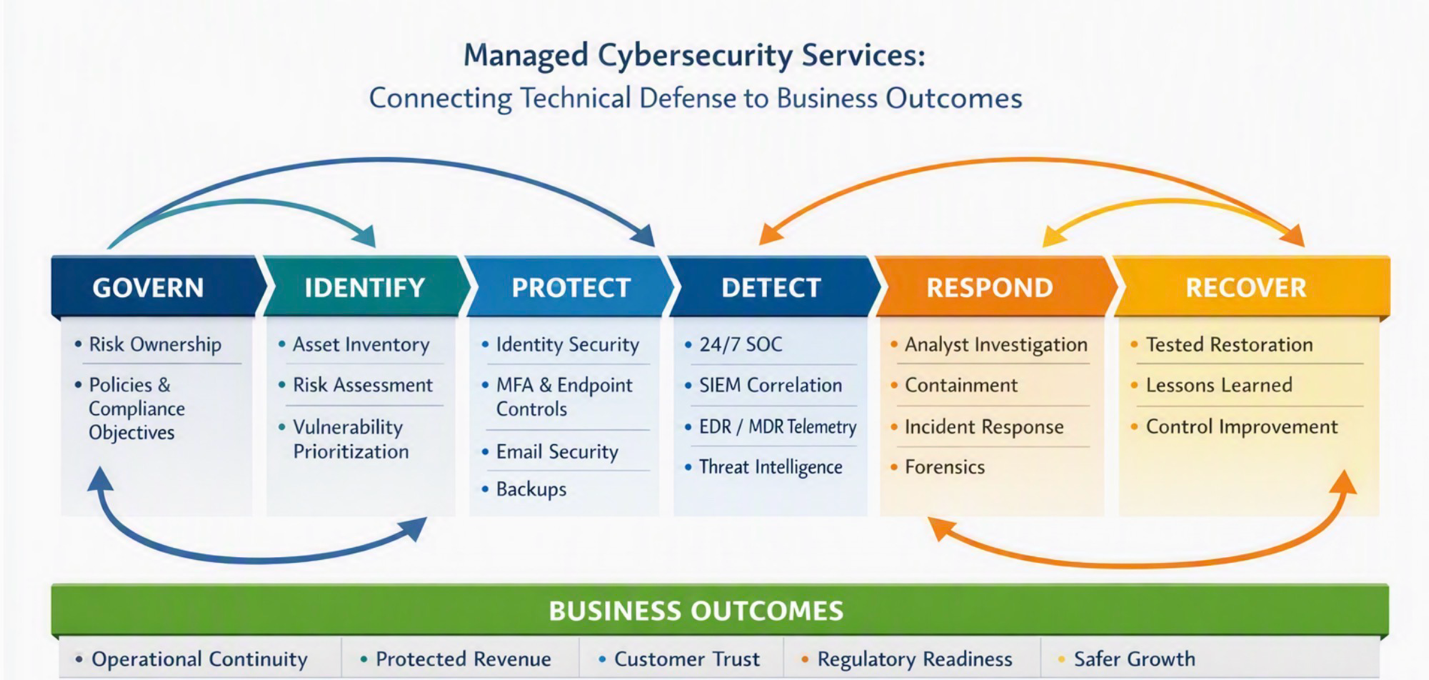
Figure 1: Managed cybersecurity links governance, continuous risk reduction, 24/7 detection, incident response, and recovery to measurable business outcomes such as continuity, trust, and safer growth.
6. Measure Outcomes That Leadership Can Use
Boards and executives do not need a monthly recital of blocked events. They need to understand exposure, readiness, material incidents, unresolved decisions, and the effect of security work on business continuity.
Useful measurements include:
Critical vulnerabilities remediated within policy
MFA and privileged-access coverage
Mean time to investigate and contain incidents
Restore-test success and recovery performance
High-risk third-party findings
Security-awareness reporting behavior
Exceptions awaiting executive acceptance
Progress against a recognized framework
NIST CSF 2.0 was explicitly created to improve prioritization and communication of cybersecurity efforts. IBM’s research also connects faster identification and containment with lower average breach costs in its studied population.
Metrics should provoke decisions. If a report does not identify what changed, what remains exposed, and what leadership must approve, it is administrative debris.
7. Choose a Partner That Can Prove How It Operates
A provider should be evaluated on evidence rather than adjectives. Ask who monitors the environment, where analysts are located, how incidents are escalated, whether response is included, which tools are supported, how customer data is protected, and what happens when the relationship ends.
Nexigen states that it offers a U.S.-based in-house security team, customizable plans, risk and vulnerability assessments, managed SIEM and EDR, incident response, forensics, penetration testing, phishing simulation, compliance consulting, and 24×7 security operations. Its website also reports SOC 2 Type II compliance and MSP Alliance Cyber Verify Level 3 status.
Those capabilities should be substantiated on the published page with current certification details, named subject-matter reviewers, transparent service boundaries, and relevant client evidence. Security buyers are reasonably skeptical. Give them material they can verify.
Cybersecurity Should Make Growth Safer
Effective cybersecurity reduces the likelihood that a preventable weakness becomes a prolonged interruption. It also gives leaders better information for evaluating new locations, acquisitions, cloud services, customer requirements, connected equipment, and AI adoption.
For businesses in Cincinnati, Columbus, Louisville, Northern Kentucky, and nearby markets, local accessibility can strengthen a service model—but geography cannot compensate for weak detection, vague responsibility, or poor response capability. The right managed cybersecurity arrangement combines nearby accountability with disciplined, continuous security operations.
Ready to understand where your business is exposed? Request a Nexigen cybersecurity risk assessment and receive a prioritized discussion of vulnerabilities, identity risk, monitoring coverage, response readiness, and recovery capability.
-
Managed cybersecurity services provide continuing external expertise for functions such as security monitoring, threat detection, incident response, vulnerability management, compliance support, and security reporting. The exact responsibilities vary substantially, so buyers should verify what is monitored and what response activity is included.
-
An MSSP commonly manages security technologies and monitoring. MDR places greater emphasis on active investigation, threat hunting, and response. The label alone is unreliable; the contract, service description, response authority, and SLA determine what the customer actually receives.
Are managed cybersecurity services only for small businesses?
No. SMBs may use them as an alternative to building a complete security operation, while mid-market and enterprise organizations may use co-managed services to supplement internal teams, extend coverage, or add specialized capabilities. NIST CSF 2.0 applies regardless of organizational size or maturity.
-
Cybersecurity supports growth by protecting availability, confidential information, customer obligations, and the systems that generate revenue. It also gives management a more reliable basis for accepting risk when adding technology, vendors, employees, and locations.
-
The required scope depends on risk, but common capabilities include risk assessment, identity protection, vulnerability management, endpoint and cloud monitoring, SIEM or MDR, security awareness, incident response, backup validation, and executive reporting.
-
Evaluate operating model, service boundaries, analyst expertise, response authority, certifications, reporting, relevant client experience, contract portability, recovery support, and the provider’s own security controls. Avoid selecting solely on a product list or lowest monthly price.
Ready to Take the Next Step? Let’s Talk
Have questions or want to learn more about how we can help your business? Fill out the form below and a member of our expert team will reach out shortly.